
India's beverage importers are evaluating coconut water with watermelon juice as a single-serve format that pairs a familiar tropical base with a mainstream fruit flavour, and the paperwork trail is now deciding which cans actually reach shelf. Label declarations, halal documentation, food safety certification and shelf-life statements carry as much weight as taste during import clearance reviews. RITA Coco Juice has built its 325ml aluminium can proposition around exactly this documentation, giving buyers a traceable path from raw material sourcing through to the shipping container.
Key Takeaways
- Regulatory filings and label declarations now shape shelf placement for imported coconut water blends as much as flavour does.
- The RITA Coco Juice 325ml can carries a 24-month shelf life declaration alongside a defined certification set covering halal, BRC, FSSC 22000, GMP, HACCP and ISO 22000.
- Flexible minimum order quantities and OEM or ODM routes let buyers trial the watermelon variant before committing to full container volumes.
- Dispatch from Ho Chi Minh Port keeps confirmed order lead times at 20 to 25 days after order confirmation.
- Coconut water remains the anchor ingredient, with watermelon juice layered in as a flavour bridge for fruit-forward consumers.
Regulatory Landscape For Coconut Water With Watermelon Juice In India
Compliance now acts as the gatekeeper for imported fruit blends rather than an afterthought on the buyer's checklist.
Importers across Maharashtra, Delhi, Karnataka, Tamil Nadu, Gujarat, Uttar Pradesh, West Bengal, Rajasthan, Kerala, Andhra Pradesh and Telangana report that fruit-forward drinks travel faster through clearance when the label file is complete before the container sails. Registration with national food authorities, importer-of-record details, batch coding and a clear best-before declaration form the routine checkpoints. Distributors also ask for halal documentation when the same stock keeping unit is routed to modern trade counters, airport retail and gifting packs, which makes a halal certified beverage file a practical commercial asset rather than a formality.
For buyers mapping a tropical block on shelf, the broader coconut water catalog provides a baseline of formats against which the watermelon variant can be positioned. Placing an original coconut water can beside the watermelon blend creates a two-item tropical set that reads clearly to shoppers scanning a chiller door, while keeping the label family consistent for the compliance team.
Label Elements Under Review
The can face is the first document an inspector opens.
- Product identity stated plainly as coconut water blended with watermelon juice, avoiding ambiguous naming that can trigger queries.
- Net quantity of 325 ml printed in a legible size, matching the declaration on the outer case and the shipping documents.
- Ingredient list ordered by predominance, with any declared additives listed separately for clarity.
- Batch code and best-before date applied in a format that survives condensation and cold-chain handling.
- Importer name, address and country of origin marking consistent across can, carton and invoice.
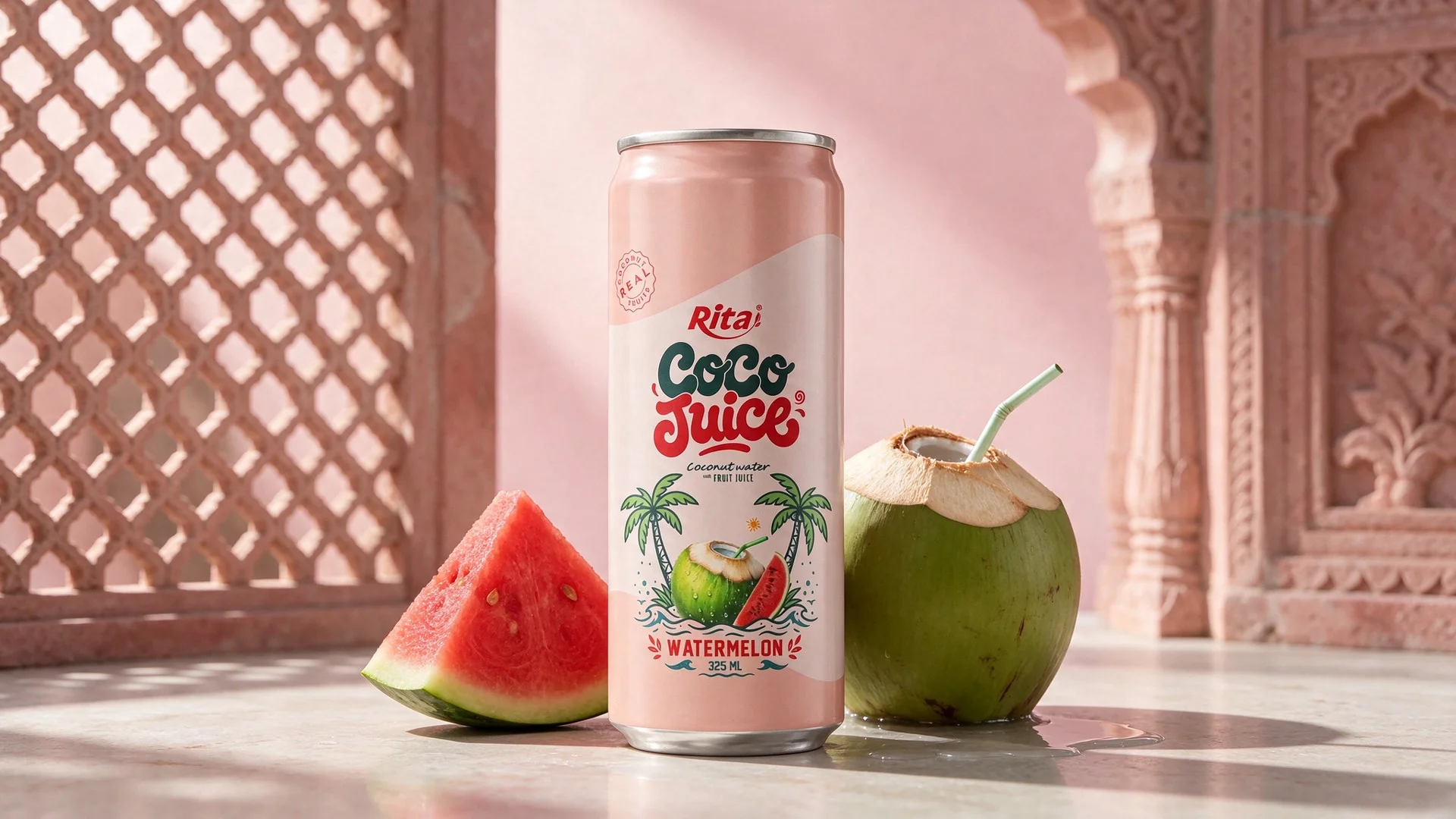
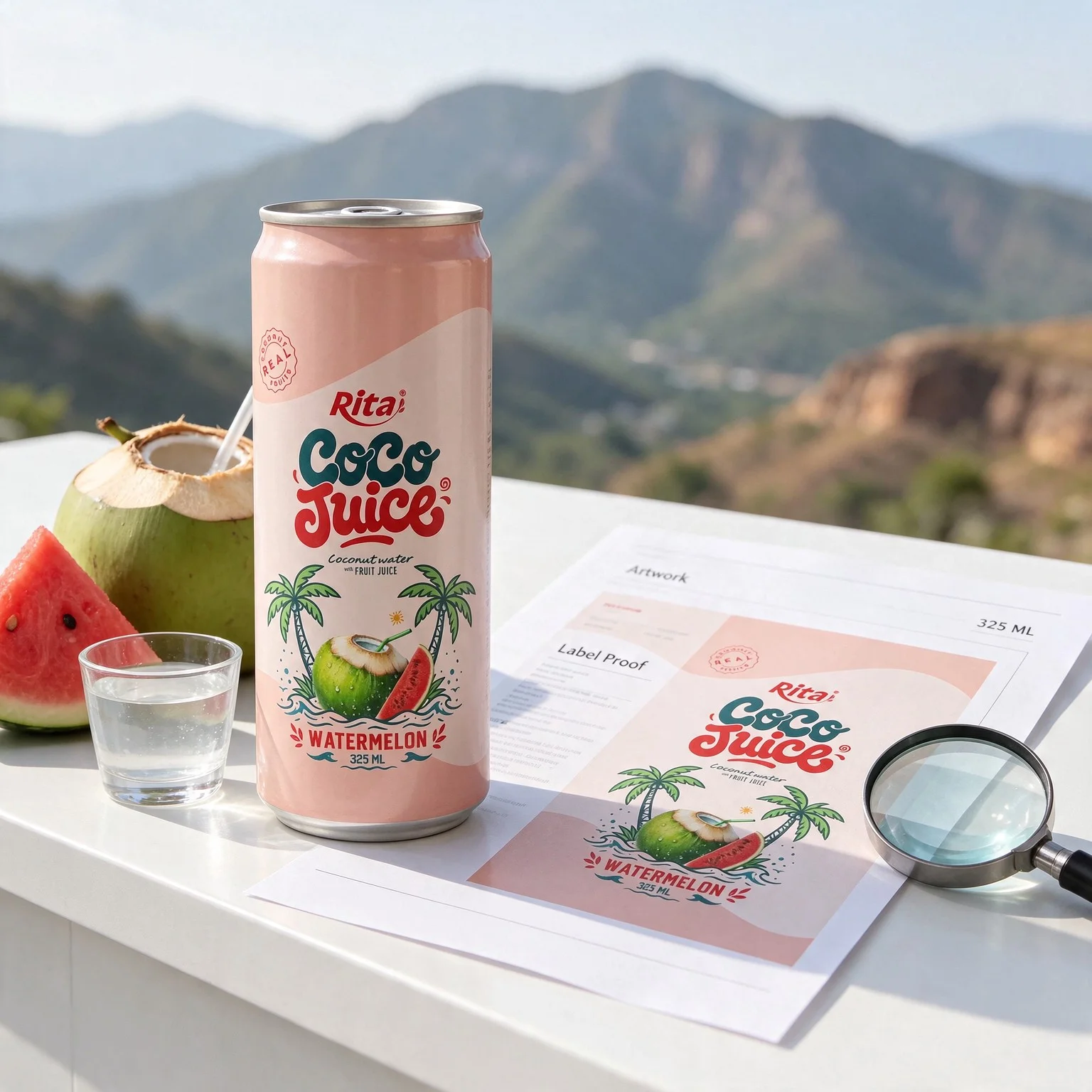
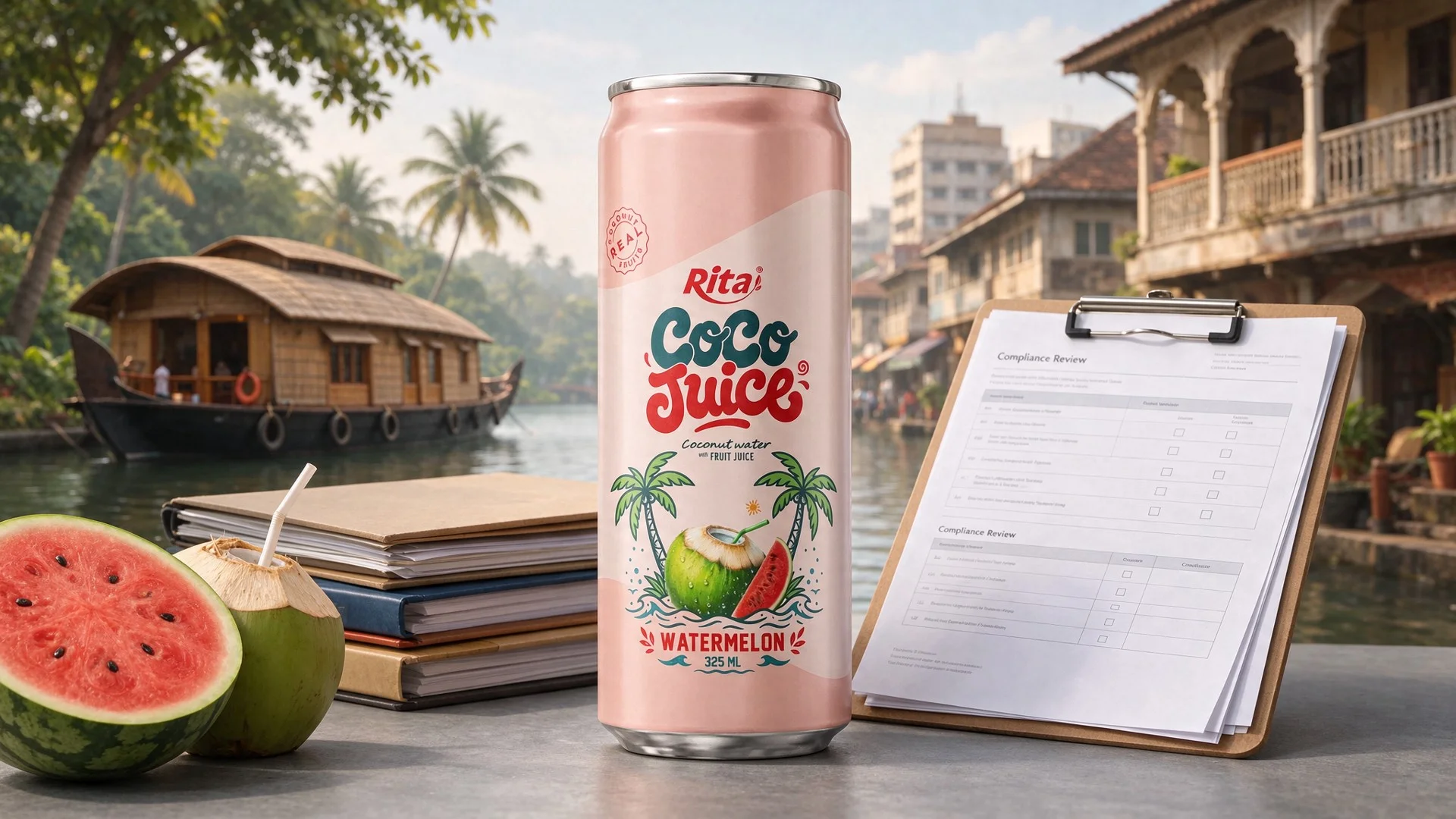
Artwork control matters as much as wording. The slim can carries a peachy-pink metallic field with palm trees, a chilled coconut and a watermelon wedge, and any regulatory text added for a destination market has to sit inside that design without crowding the illustration. Buyers who commission destination-specific artwork usually run a proofing round with the supplier before plates are made, because a mis-declared statement on ten thousand cans is expensive to correct.
Shelf Life And Storage Declarations
A 24-month shelf life changes how a container load can be planned.
With a two-year declared shelf life, importers can schedule slower-moving regional distributions without the pressure of a short dating window, and the can format supports ambient storage until the point of chill. The declaration has to be supported by the records behind it, which is where the certification stack becomes relevant. Buyers reviewing the specification sheet for the RITA Coco Juice Coconut Water with Watermelon Juice 325ml can will find shelf life, sample policy, payment terms and delivery window listed alongside the certificate icons, which shortens the due diligence conversation considerably.
Certifications Behind The Coconut Water With Watermelon Juice Can
Paperwork is the product's second label.
The certification set attached to this SKU covers the checkpoints that importers, distributors and audit teams typically request during onboarding. Certificates shown for the product include Halal, BRC Food, FSSC 22000, GMP, HACCP and ISO 22000, and buyers should confirm in writing which of these apply to the specific can before filing documents, since the supplier notes that only some of the listed certifications cover each individual item. That distinction sounds procedural, yet it prevents a mismatch between the marketing sheet and the customs file.
What Each Certificate Signals To A Buyer
Certificates answer different questions, so it helps to read them as a set rather than as a single badge.
| Certificate | Question it answers for a buyer |
|---|---|
| Halal | Is the SKU usable across channels that require a recognised halal certificate? |
| BRC Food | Does the production site align with a globally recognised food safety benchmark? |
| FSSC 22000 | Is there a complete food safety management system behind the batch records? |
| GMP | Are hygiene and process controls documented at facility level? |
| HACCP | Have critical control points been identified and monitored for this product type? |
| ISO 22000 | Is there a structured framework covering communication and verification? |
Certificate icons are published on the product listing for the RITA Coco Juice Coconut Water with Watermelon Juice 325ml can, where buyers can also request current copies of each document before placing an order.
For a beverage export certifications review, the practical sequence is to request current certificate copies, check validity dates against the planned shipment window, and match the product name on each document to the invoice description. Importers who do this before the vessel books avoid the most common cause of clearance delay, which is a document describing a different item than the one on the packing list. Current FSSC 22000 certification records, in particular, are frequently requested by modern trade buyers during supplier onboarding.
From Our Orchards: Raw Material Sourcing
Traceability starts in the field, long before a can is filled.
The coconut water base draws on sourcing networks documented in the supplier's account of the Ben Tre coconut farm journey from plantation to finished product, where raw nuts are selected and handled before processing. For buyers, an accessible sourcing story is useful during retailer audits because it answers the provenance question with a specific location rather than a general claim.
Watermelon, the second component of the blend, is drawn from the wider fruit supply area described in the supplier's overview of the Mekong Delta as a raw material base, a region that supplies a range of seasonal fruits across the beverage portfolio.
A closer look at the coconut sourcing route is available in this short field video: https://www.youtube.com/watch?v=I7hlTL3FT_0
Market And Export Outlook For The 325ml Can
Demand patterns favour formats that travel well.
Market & Export Overview
Annual Trend
| Year | Transactions (lô) | Total Value (USD) | Total Weight (kg) | Total Quantity (đv.) | YoY |
|---|---|---|---|---|---|
| 2025 | 30,736 | 587,357,440 | 521,062,036 | 288,325,563 | N/A |
| 2026 | 40,525 | 566,028,847 | 862,715,925 | 339,922,262 | +31.8% transactions; -3.6% value; +65.6% weight; +17.9% quantity |
Data source: Tradesparq Trade Data (tradesparq.com)
Coverage: Aug 2025 – Aug 2025 (AI TradeSeek). The two yearly rows reflect unequal, partial-year periods within this window and should not be read as directly comparable full calendar years.
Top Origin & Destination Countries
| Type | Country | Transactions (lô) | Total Value (USD) | Weight (kg) | Market Share | Avg. Price (USD/đv.) |
|---|---|---|---|---|---|---|
| Destination | United States | 33,501 | 376,251,733 | 1,118,492,507 | 47.3% | 1.51 |
| Destination | Australia | 3,262 | 54,453,356 | 438,020 | 4.6% | 2.46 |
| Destination | Vietnam | 3,175 | 40,383,813 | 8,023,765 | 4.5% | 1.37 |
| Destination | Singapore | 3,122 | 89,723,882 | 9,651,955 | 4.4% | 0.79 |
| Destination | Netherlands | 2,347 | 108,766,617 | 30,248,792 | 3.3% | 4.05 |
| Destination | Peru | 1,766 | 7,125,398 | 1,247,942 | 2.5% | 3.73 |
| Destination | United Kingdom | 1,604 | 40,931,218 | 37,707,131 | 2.3% | 5.54 |
| Destination | Mexico | 1,399 | 11,812,236 | 10,699,694 | 2.0% | 2.40 |
| Destination | Costa Rica | 1,242 | 60,704,775 | 948,396 | 1.8% | 113.25 |
| Destination | Canada | 1,167 | 37,373,105 | 17,070,499 | 1.6% | 3.28 |
| Origin | N/A (not reported in source) | N/A | N/A | N/A | N/A | N/A |
Data source: Tradesparq Trade Data (tradesparq.com)
Top HS Codes by Transaction Count
| HS Code | Description | Transactions (lô) | Total Value (USD) | Weight (kg) | Market Share | Avg. Price (USD/đv.) |
|---|---|---|---|---|---|---|
| 200989 | Single fruit/vegetable juices, other | 24,208 | 466,501,000 | 487,667,981 | 34.4% | 1.49 |
| 220299 | Other non-alcoholic beverages | 9,126 | 77,862,232 | 70,227,940 | 12.9% | 3.41 |
| 200939 | Citrus juices, not frozen, Brix >20 | 3,259 | 167,206,615 | 16,600,794 | 4.6% | 3.83 |
| 330300 | Perfumes / toilet waters | 2,029 | 2,761,138 | 527,788 | 2.9% | 14.48 |
| 210690 | Other food preparations | 1,949 | 18,397,993 | 37,784,144 | 2.8% | 0.82 |
| 200990 | Mixtures of juices | 1,916 | 11,640,495 | 11,953,665 | 2.7% | 3.00 |
| 220210 | Waters with sugar/flavouring | 1,833 | 1,855,697 | 7,119,711 | 2.6% | 1.63 |
| 200969 | Grape juices, other | 1,616 | 111,500,040 | 34,905,877 | 2.3% | 2.04 |
| 481190 | Other paper/board cellulose | 1,294 | 13,713,003 | 0 | 1.8% | 1.86 |
| 200819 | Other prepared nuts and seeds | 839 | 38,164,473 | 42,311,897 | 1.2% | 26.41 |
Data source: Tradesparq Trade Data (tradesparq.com)
Monthly Trend
| Month | Transactions (lô) | Suppliers | Buyers | Value (USD) | Weight (kg) | Quantity (đv.) |
|---|---|---|---|---|---|---|
| 08/2025 | 4,302 | 525 | 779 | 142,678,668 | 77,677,963 | 45,887,623 |
| 09/2025 | 7,855 | 726 | 1,094 | 139,802,666 | 117,807,295 | 75,675,783 |
| 10/2025 | 6,314 | 782 | 1,129 | 105,399,453 | 108,021,255 | 56,992,681 |
| 11/2025 | 6,063 | 706 | 1,092 | 98,089,214 | 102,970,287 | 53,182,463 |
| 12/2025 | 6,202 | 742 | 1,123 | 101,387,439 | 114,585,236 | 56,587,013 |
| 01/2026 | 5,817 | 707 | 1,054 | 92,014,530 | 104,455,785 | 54,522,281 |
| 02/2026 | 4,603 | 631 | 936 | 81,648,340 | 90,206,678 | 43,010,356 |
| 03/2026 | 5,976 | 724 | 1,049 | 96,953,671 | 127,046,703 | 51,901,384 |
| 04/2026 | 6,728 | 783 | 1,113 | 105,058,314 | 127,395,784 | 60,112,681 |
| 05/2026 | 7,110 | 788 | 1,145 | 107,163,899 | 121,724,363 | 62,956,533 |
| 06/2026 | 6,455 | 691 | 1,045 | 67,721,003 | 129,305,692 | 46,673,214 |
| 07/2026 | 3,088 | 330 | 427 | 15,469,090 | 130,130,579 | 16,567,698 |
| 08/2026 | 748 | 141 | 166 | 0 | 32,450,340 | 4,178,115 |
Data source: Tradesparq Trade Data (tradesparq.com)
Note: the reported value of 0 for 08/2026 is a reporting artefact of an incomplete month and is not evidence of zero actual trade value.
The coconut water trade market shows volume-led growth: transaction count rises from 30,736 to 40,525 and weight from 521,062,036 kg to 862,715,925 kg, while total value moves from 587,357,440 USD to 566,028,847 USD — indicating a shift toward bulk shipments and lower average unit prices. Monthly activity is seasonal, peaking at 7,855 transactions in 09/2025 and 7,110 in 05/2026, and falling to 748 in 08/2026 during the low season.
By destination, the United States accounts for 47.3% of transactions (33,501 lô, 376,251,733 USD, 1,118,492,507 kg) at an average price of 1.51 USD/đv., followed by Australia (4.6%), Vietnam (4.5%), Singapore (4.4%) and the Netherlands (3.3%). Premium-priced destinations include the United Kingdom at 5.54 USD/đv. and Costa Rica at 113.25 USD/đv., while Singapore averages 0.79 USD/đv. as a regional re-export hub. On the product side, HS 200989 leads with a 34.4% share at 1.49 USD/đv., and HS 220299 holds 12.9% at 3.41 USD/đv., reflecting demand for value-added, flavoured and functional coconut beverages.
Single-serve cans remain a preferred format for impulse purchase, and the 325ml size sits in a band that works for on-the-go consumption, office pantries and travel retail shelves. Retailers building a fruit-forward fixture often place coconut water can lines beside juice blends, which is where a coconut water with watermelon juice pairing earns its shelf position without cannibalising the original variant. The wider fruit juice catalog gives buyers a reference point for how the blend sits within a broader portfolio conversation.
OEM And Private Label Routes For Buyers
Private label is where regulatory control and commercial margin meet.
RITA Food and Drink Co., Ltd, established in 2004, operates as a Vietnamese OEM and ODM beverage manufacturer exporting to more than 180 countries, with over 50 automated production lines and around 1,200 containers shipped monthly. For an importer evaluating an OEM beverage manufacturer partner, that scale matters when a trial order has to convert into repeat shipments on a predictable calendar.
The watermelon variant is offered under the RITA brand or as an OEM arrangement, so a buyer can test the market with existing artwork first and move to private label once the SKU proves itself. Sample policy, flexible MOQ, payment terms of L/C or T/T and a delivery window of 20 to 25 days after order confirmation are published on the RITA Coco Juice Coconut Water with Watermelon Juice 325ml can listing, which shortens negotiation cycles between buyer and supplier.
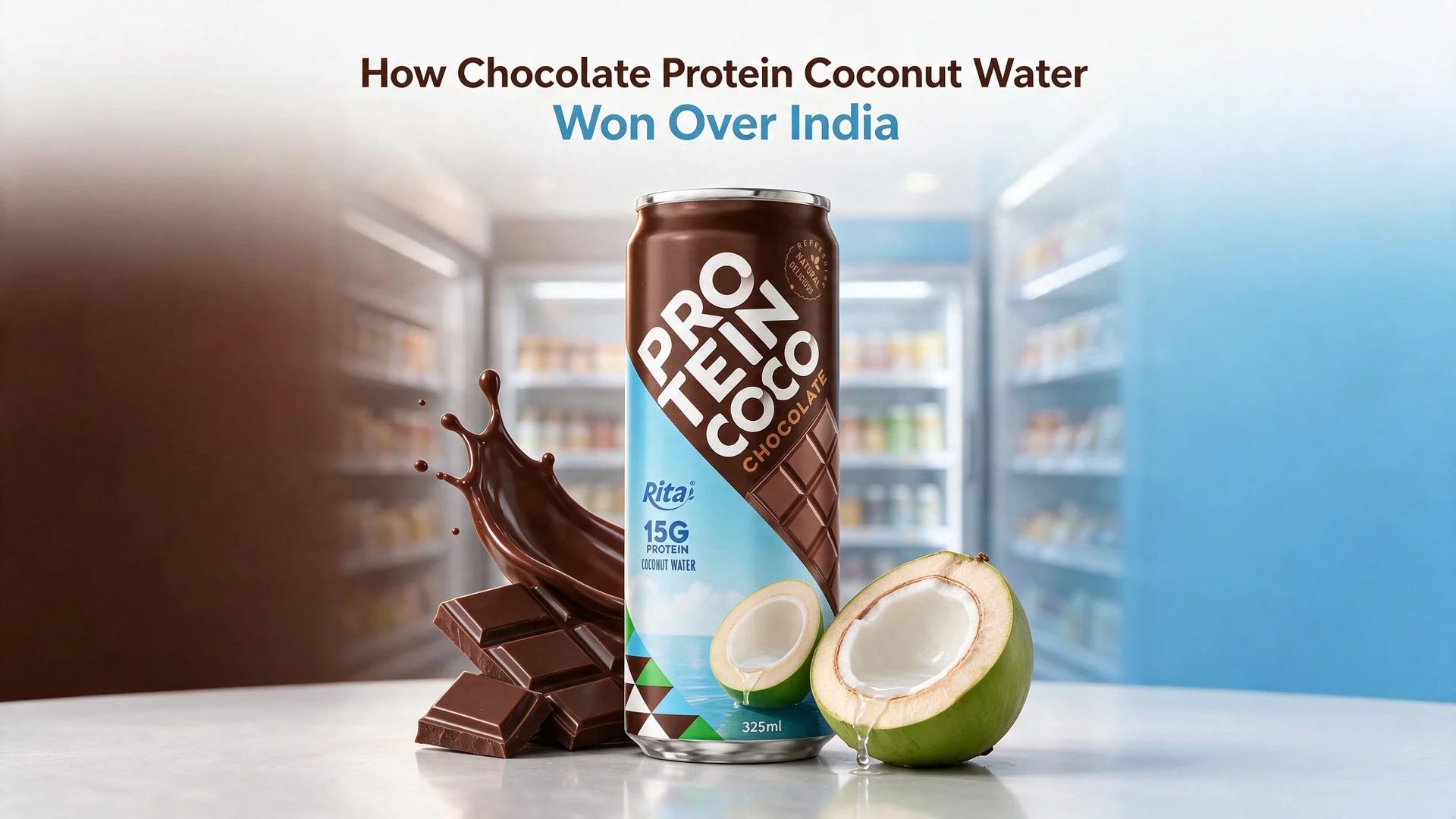
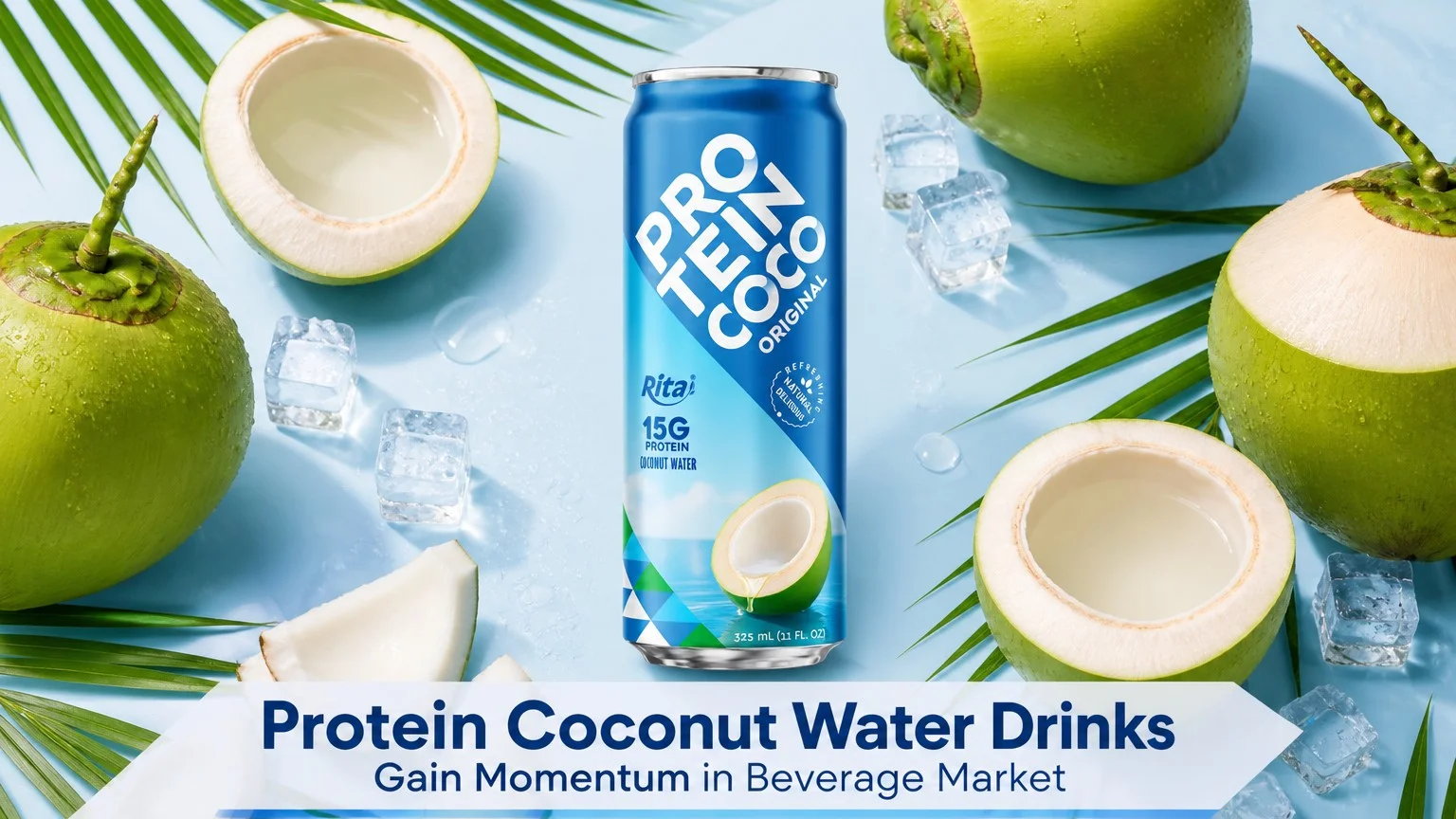
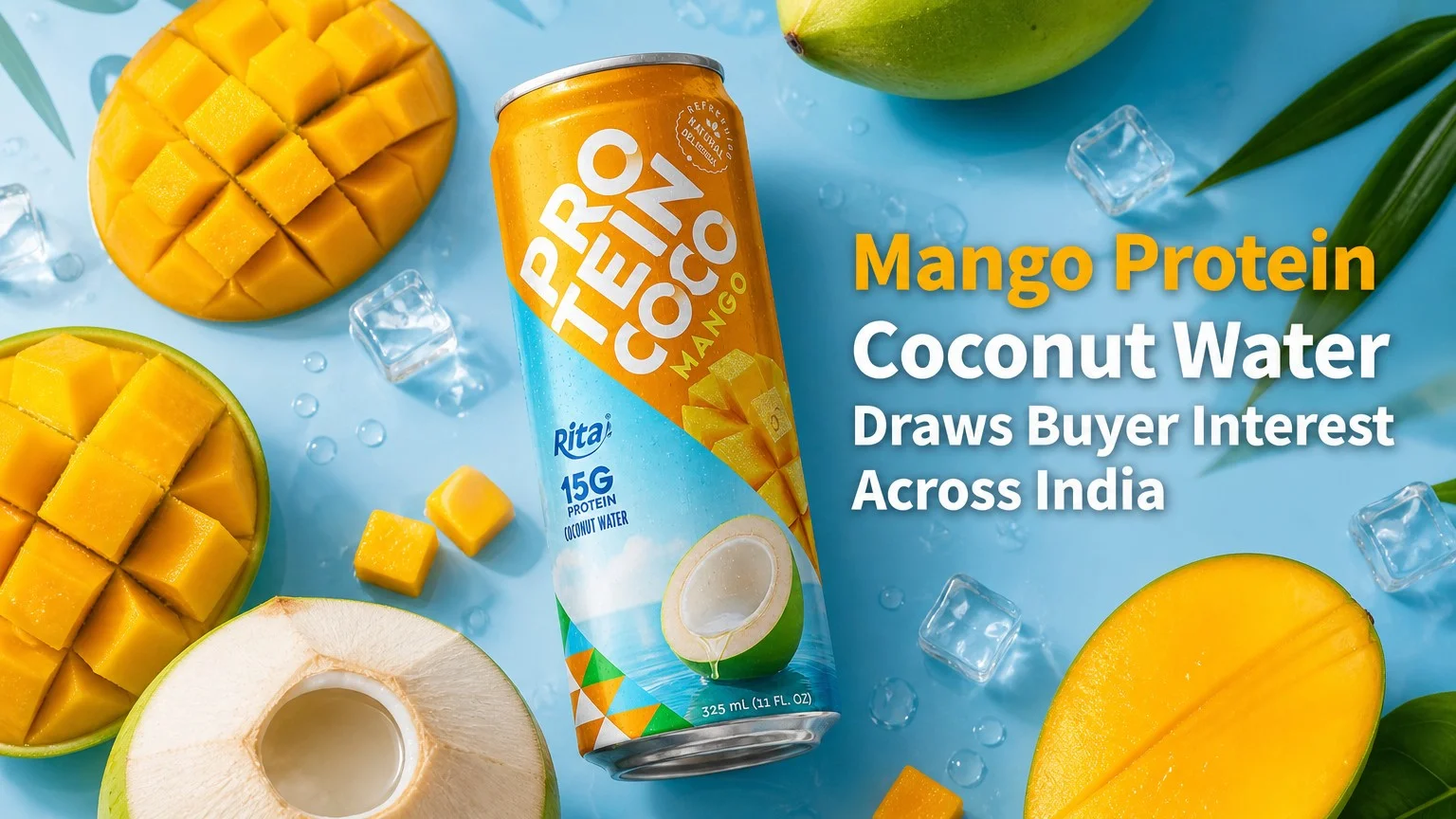
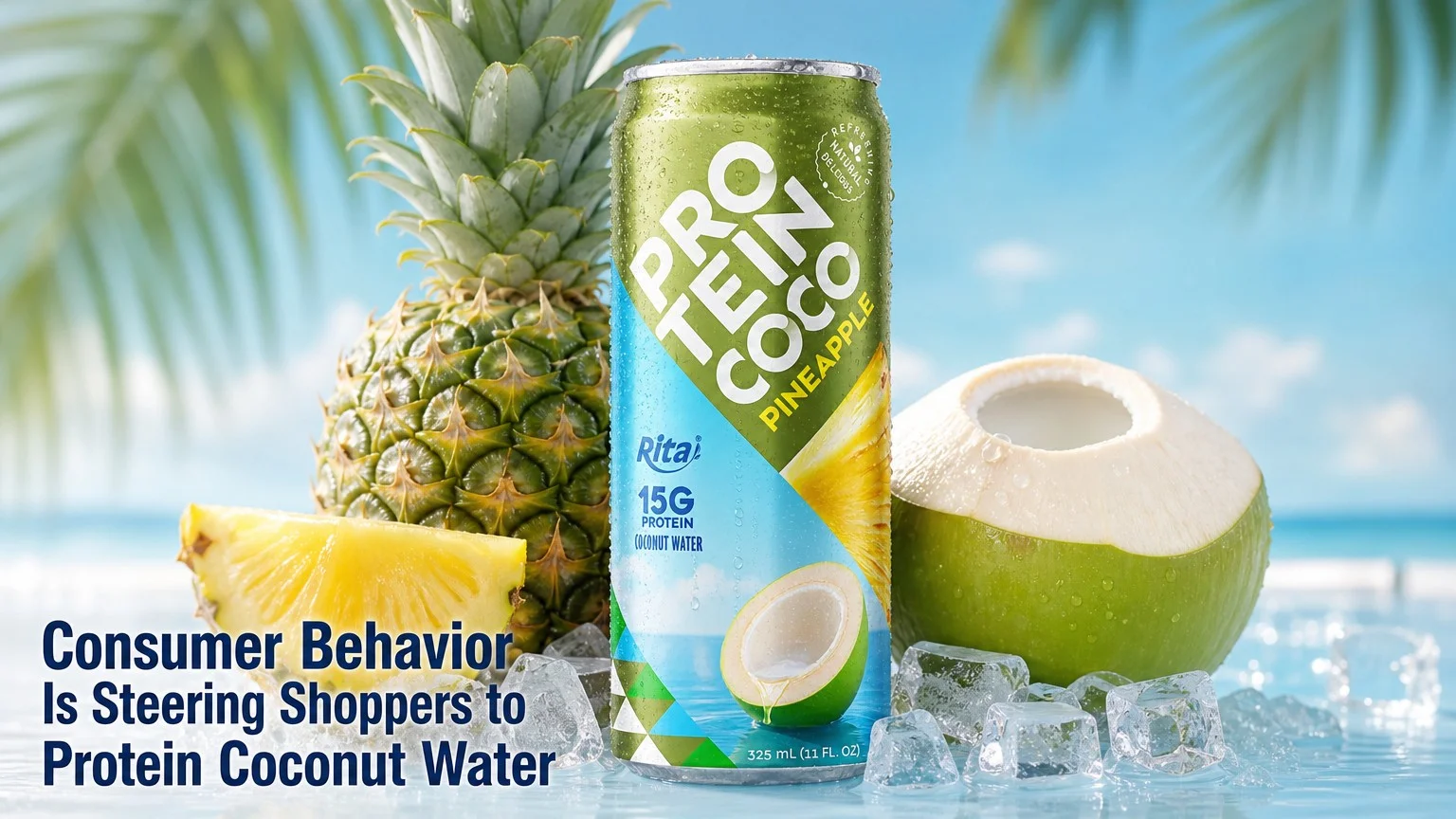
Documentation support typically runs alongside artwork approval: certificate copies, specification sheets, shelf-life statements and catalogue references are assembled before the first purchase order is raised. Buyers who request the full catalogue at the start of the conversation can benchmark the watermelon can against the other flavours in the Coco Juice family, namely original, pineapple, cucumber, blueberry, mango, and lime and salt, and decide whether to launch a single SKU or a coordinated range under the RITA Coco Juice banner.
For buyers who prefer to broaden the range beyond coconut, the same supplier relationship covers tropical fruit juices, soft drinks and other canned formats, which keeps one compliance file working across several categories rather than restarting the process for every new item introduced to the portfolio.
Frequently Asked Questions
Which certifications apply to the RITA Coco Juice Coconut Water with Watermelon Juice 325ml can?
Certificates shown for this SKU include Halal, BRC Food, FSSC 22000, GMP, HACCP and ISO 22000. The supplier states that only some of the listed certifications apply to each individual product, so buyers should request written confirmation of the applicable set before filing import documents.
What is the declared shelf life of the 325ml coconut water and watermelon juice can?
The product is listed with a 24-month shelf life, which supports ambient storage and staged regional distribution for importers planning container schedules.
Can the watermelon coconut can be ordered under private label?
Yes. The SKU is available under the RITA brand or through an OEM and ODM arrangement, with flexible MOQ, free samples on request, and payment terms of L/C or T/T.
What are the shipping terms for this can?
Orders are dispatched from Ho Chi Minh Port, Vietnam, with a delivery time of 20 to 25 days after order confirmation.
Which other flavours sit in the same coconut water range?
The Coco Juice family includes original, pineapple, cucumber, blueberry, mango, and lime and salt alongside the watermelon variant, allowing buyers to build a coordinated multi-flavour set.